physics_tracker
Real-time kinematics analysis engine utilizing Computer Vision (OpenCV) and Finite Difference methods to extract physical vectors from video feeds.
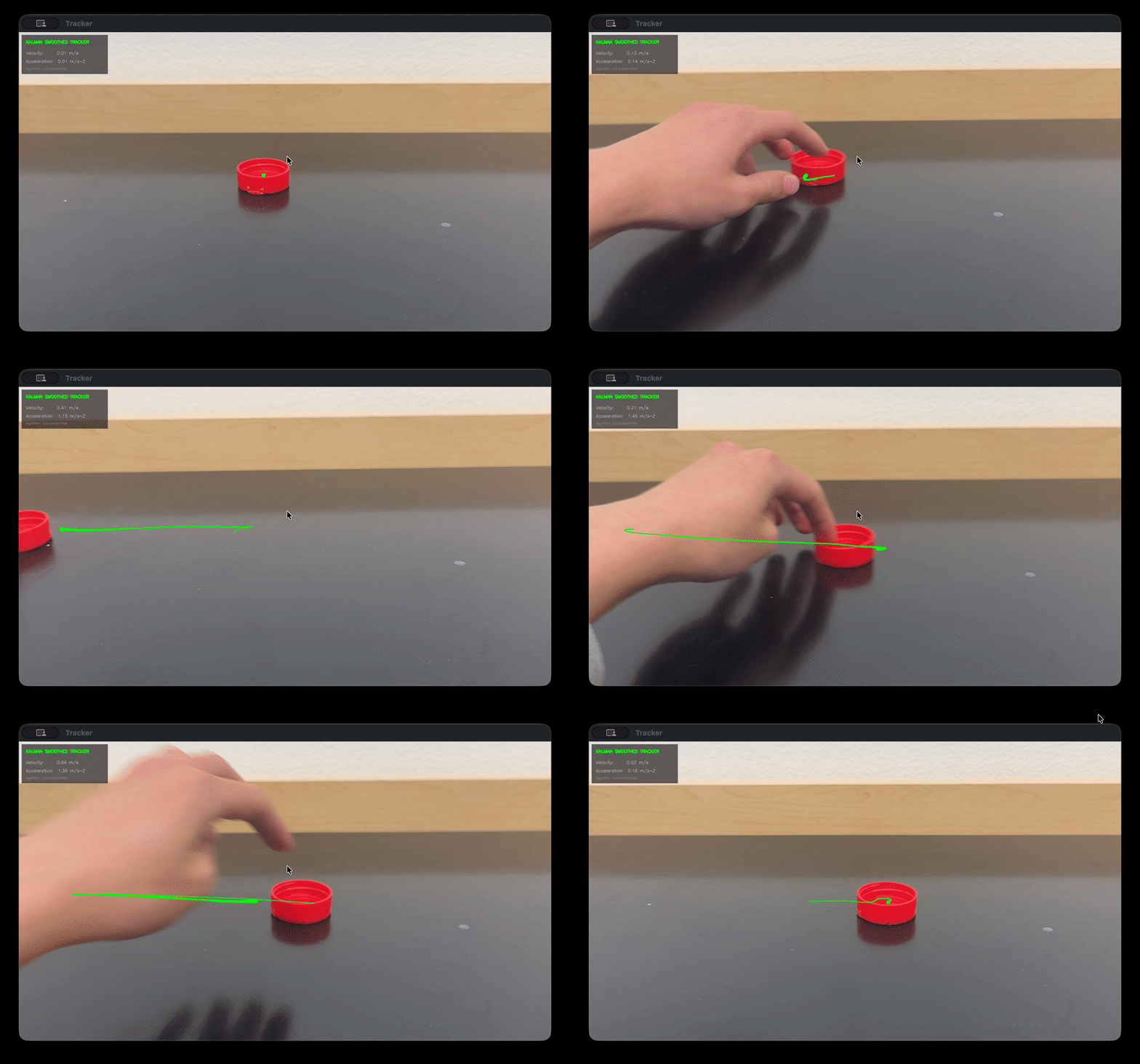
Kinematics-CV: Real-Time Physics Analysis Engine



A computational tool designed to bridge the gap between theoretical mechanics and real-world experimental data acquisition.
🚀 Overview
Kinematics-CV is a high-performance computer vision engine built to track projectile motion in real-time. Unlike standard tracking scripts, this system implements a physics-first architecture, converting raw pixel data into meaningful kinematic vectors (Velocity $\vec{v}$ and Acceleration $\vec{a}$) with industrial-grade signal processing.
I developed this tool to address a common challenge in undergraduate physics labs: the disconnect between idealized textbook formulas and noisy real-world measurements.
✨ Key Features (Engineering & Math)
1. Robust Computer Vision Pipeline
- HSV Color Space Segmentation: Utilizes Hue-Saturation-Value masking instead of RGB to ensure robustness against varying lighting conditions in the lab.
- Morphological Noise Reduction: Implements erosion and dilation algorithms to filter out high-frequency visual noise before processing.
- Centroid Calculation: Computes Image Moments ($M_{00}, M_{10}, M_{01}$) to determine the precise center of mass of the tracked object.
2. Physics & State Estimation Core: Linear Algebra
- Linear Kalman Filter (LKF): Instead of simple smoothing, I implemented a stochastic state estimator.
- State Space Model: The system tracks the state vector $\mathbf{x} = [x, y]^T$ using a transition matrix $\mathbf{F}$ (Identity) and measurement matrix $\mathbf{H}$.
- Covariance Tuning: By manipulating the Process Noise Covariance ($\mathbf{Q}$) and Measurement Noise Covariance ($\mathbf{R}$) matrices, the engine dynamically weights the “trust” between the physical inertia model and the camera sensor data.
- Finite Difference Method: Approximates instantaneous derivatives from the smoothed state estimate: \(v \approx \frac{\Delta x_{kalman}}{\Delta t}, \quad a \approx \frac{\Delta v}{\Delta t}\)
3. Scientific Visualization (HUD)
- Renders a real-time Heads-Up Display overlaying physical data on the video feed.
- Visualizes trajectory paths with a dynamic “comet-tail” buffer (
deque) for immediate path analysis. - Visual Debugging: Displays both the Raw Sensor Input (Red) and the Kalman Estimate (Green) to visualize the noise reduction in real-time.
🛠️ System Architecture
The project follows a modular Object-Oriented Programming (OOP) structure to ensure scalability for future lab instrumentation integration.
- Encapsulation: The
PhysicsTrackerclass manages state variables (velocity,acceleration,buffers) locally, preventing global namespace pollution. - Time Complexity Optimization: Utilizes
collections.dequefor the trajectory buffer, achieving O(1) time complexity for append and pop operations, which is critical for maintaining high frame rates during real-time analysis. - Scalability: The code is designed to support ArUco marker calibration and multi-object tracking in future iterations.
⚡ Quick Start
Prerequisites
- Python 3.x
- Webcam (Built-in or USB)
Dependencies
opencv-pythonnumpy
Installation
- Clone the repository:
git clone https://github.com/timothyzhbw-jpg/physics_tracker.git cd physics_tracker - Install required packages:
pip install -r requirements.txt - Run the engine:
python physics_tracker_roi.py
🔭 Future Roadmap: From 2D to 3D Lab Assistant
The current version serves as a proof-of-concept. The next development phase focuses on evolving the engine into a Stereoscopic Physics Station to handle complex 3D mechanics.
1. Stereo Vision & Depth Perception (The “3D Upgrade”)
- Dual-Camera Implementation: Implementing Epipolar Geometry algorithms to fuse video feeds from two calibrated cameras.
- 3D Triangulation: By calculating the disparity map between left and right channels, the system will extract the $z$-coordinate (Depth), upgrading the tracking state vector from 2D $[x, y]$ to 3D $[x, y, z]$.
2. Automated Calibration System
- Intrinsic & Extrinsic Matrix Calculation: Developing a routine to automatically compute camera parameters (focal length, optical center) and relative poses using a standard checkerboard pattern (Zhang’s Method).
- Distortion Correction: Applying radial and tangential distortion coefficients to rectify wide-angle lens curvature for high-precision measurement.
3. Data Visualization & Serialization
- 3D Trajectory Plotting: Integration with
matplotlib(mplot3d) orPlotlyto automatically generate interactive 3D Scatter Plots of the projectile’s path post-experiment. -
Universal Data Export: Auto-serializing kinematic data (Timestamp, Position $\vec{r}$, Velocity $\vec{v}$, Acceleration $\vec{a}$) into structured
.csvor.jsondatasets, ready for immediate analysis in MATLAB or Python/Pandas.
Author
Bowen Zhang University of California, Santa Barbara